Reading time: 13 - 16 mins
🎧 Prefer to listen? Tap play on the audio version here...
A part of being human is experiencing this sense of “I’m not enough”. And for those of us who struggle with binge eating, we’ve usually picked up the belief that “I’d be more lovable and acceptable if my body looked a certain way” - slim, toned and smooth with just the right amount of curves in the right places.
So to try and meet this deeply rooted need to feel enough - to feel worthy - we make it our mission to get the “ideal body”. We go on diets, restricting the amount we eat, the foods we eat and the times we eat. Perhaps we also workout more. And it’s this need to feel enough, along with the belief that when we have that body we’ll be worthy, the steps we take to get it, and the shame we feel when we don’t have it, that create a perfect storm for binge eating.
As Highly Sensitive People (HSPs), we might also feel like we don’t quite fit in with the world, or we might take in these cultural messages around weight and worth at a deeper level, creating more of a vulnerability to binge eating, or weaving the cycle tighter.
If you see yourself within this, we’re going to take a closer look at how you perhaps got here - exploring the ties between self-worth, being highly sensitive and binge eating, and how you can find freedom from binges by both understanding your worth as a HSP, and connecting to your innate worth.
These are the master keys that not only take us towards binge eating recovery, but also a richer and more meaningful life. It’s why I chose to call my coaching business Binge Free & Worthy - the “worthy” part being the core of the work we do together. For me, it was through changing my relationship to worth, especially as a HSP, that I was able to stop binge eating and see the truth of who I really am more clearly.
“Why do I feel unworthy or not enough?”
Before we look at the ways that our sense of worth plays into our relationship with food and our body, let’s take a step back to understand what worth is. Again, this feeling of “I’m not enough” comes up for us all to some degree; it’s a shared experience that’s perhaps not often talked about. And I hope reading this article feels like an exhale because, truly, you are far from alone in it.
Over the last few years, I’ve come to know worth on two core levels: innate worth and self-worth. Both of these are interconnected, where self-worth can fluctuate depending on how rooted you are in your innate worth. Let me do my best to explain…
Innate worth
Innate worth is the intrinsic value, deservingness and lovability that you have simply because you exist. It is universal, unconditional and constant - nothing that you could ever do could impact it (including losing and gaining weight).
This is the realm of the spiritual. Perhaps you’ve had moments where you’ve felt this sense of connection to something greater; a stillness, an opening, a knowing. Maybe a feeling of love and acceptance that is bigger than you. For me, I’ve felt this as a never-ending stream of love that pours into itself and flows through us all. Now I know this might be getting a little “out there”, and we’re about to go a touch further out, but please stay with me!
For many of us, this innate worthiness isn’t something we’re even aware of, let alone actively connecting to. But it is there. If you're wondering, 'Well, why aren't I aware of it?', one belief is that although we are always innately worthy, we veil this truth from ourselves by design - that our souls choose to come to Earth to experience this illusory separation simply for that: the experience.
Another perspective is that part of the meaning of life is to come full circle - to go on this journey of seeking the love and acceptance we crave outside of ourselves, to eventually discover it’s only truly found within. With both views, when we’re open and receptive to our innate worth, and see all the ways we’ve hidden ourselves from it, we clear away the veil.
I realise this might feel abstract or even uncomfortable if it's new to you, and that's okay. You don't need to fully embrace any spiritual idea to benefit from what follows. What I'm really pointing to is this: there's a kind of worth that exists independent of anything you do, how you look, or what you achieve. Some people experience this as a spiritual knowing, others as a psychological anchor, and others simply as a perspective worth exploring. However it makes sense to you is wonderful.
The Sufi mystic Rumi spoke to this unchangeable essence beautifully…
“Your task is not to seek for love, but merely to seek and find all the barriers within yourself that you have built against it.”
― Rumi
Self-worth
Self-worth, however, is subjective and refers to how you perceive value in yourself. It’s influenced by the beliefs we’ve formed from the people in our lives and the wider culture, especially by what we experienced in our early years. It’s all about us wanting to feel lovable, acceptable and therefore safe - what’s actually a really wise survival adaptation.
Because of this, there are varying degrees of self-worth that we can feel, as well as various places that our self-worth is rooted in. For some of us, that’s a lot about how we look - the shape of our bodies and how we present ourselves to the world. For others, it’s more about what we do and can achieve. Usually, it’s a blend of the two.
When we’re disconnected from, or not believing in our innate worthiness, we often do things in order to feel more worthy, or prove our worth to others. This can look like anything from needing to have a full social life, or having perfectly clear skin, to giving more than is supportive to us at work. From this place, we’re trying to control or get more of something to fill the “I’m not enough” void.
However, being rooted in a sense of innate worth helps you to build a healthier sense of self-worth. When you know deep down that you are innately worthy, it’s easier to untether yourself from doing these things that ultimately aren’t you, or don’t serve you. This isn’t about becoming “egoless” or transcending who we are and what we do (ideas you may have picked up from some spiritual teachings). It’s about resting into your innate worth and discovering who you truly are, and how that’s expressed, when you let go of doing to prove.
“Tear off the mask. Your face is glorious.”
― Rumi
“But if I felt innately worthy…”
“What does binge eating have to do with self-worth?”
As we touched on in the beginning,
binge eating and binge eating disorder (BED) (which affects around 2% of women in the UK [1] and 3.5% of women in the USA [2] at some point during their lives) are often rooted in low self-worth and a feeling of “I’m not good enough” or “I’m not acceptable as I am”. We all have our own patterns around trying to make ourselves more worthy, in our own eyes and the eyes of others. And in the case of binge eating, this can look like trying to get or maintain the body size that we see as the “dream body”.
We believe that when we have that body, everything else will fall into place. That we’ll finally feel good enough, that we'll love ourselves and be loved, and that everything will just be easier. We believe we’ll be safe and secure as a result.
Why we attach worth to our bodies
Worth and body image are so intricately woven in our culture, it’s no surprise that many of us find ourselves here. We’ve been fed the message all throughout our lives that our bodies, beauty, and youthfulness are like a form of currency. And this message unfortunately comes at us from all angles, in both subtle and not-so-subtle ways.
This perhaps originates from seeds of truth, that firstly, when it comes to the primal need to procreate, we tend to seek partners who are healthy. It’s fundamental to the survival of our bloodline. Secondly, we are drawn to beauty, and therefore, being beautiful can be seen as a form of safety.
However, these survival strategies have become warped over time, to a point where they’re dramatically backfiring on us. They no longer serve us when we associate “health” and “beauty” with the very narrow and outward perceptions we now have. Perceptions that actually create unhealthy and harmful patterns in the pursuit of them. That takes us further away from true vitality and the radiance that comes with knowing your innate worth.
We might also see our bodies as something we can control, or perhaps “should” be able to control. And so when the outside world feels unpredictable and therefore unsafe, our bodies can become the focal point for building our sense of worth.
What's more, in a kind of “cosmic joke” way, our innate worthiness - that which is unchangeable and always within us - can require some of the most challenging and dedicated inner work to experience. Or at least experience in a somewhat consistent way. From here, trying to feel more worthy through things like weight loss, cosmetics, achievements, or anything else can feel like an easier route to take.
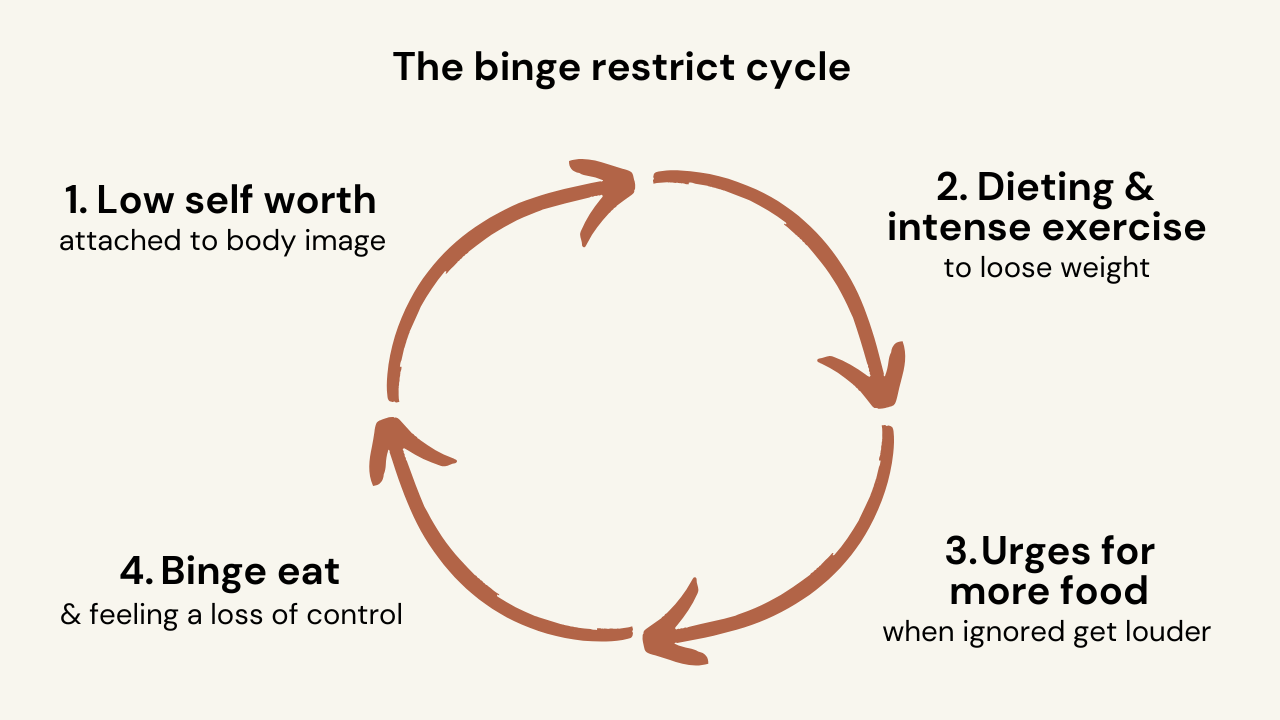
The binge restrict cycle
When we attach weight loss to our worth, the impact of food restrictions like diets, fasts or “just being good” can set us up for what’s referred to as the
binge restrict cycle. It’s a common cycle that perhaps you’ll recognise yourself in…
Stage 1: You feel the sense of “not enough”, and wrapped up within your self-worth are beliefs around weight. Because of this, you see the answer to being more lovable and worthy as weight loss.
Stage 2: You restrict your food in some way, perhaps reducing calories, fasting or cutting out particular foods or food groups altogether. You may also workout more or more intensely.
Stage 3: Your body sends signals urging you to eat more, or urging you to eat specific foods that you’ve cut out. These signals can be sent for multiple reasons, for example -
On the physical level, you may not be meeting your energy and nourishment needs.
On the psychological level, you may have triggered the “forbidden fruit effect”, where you’ve created more desire for a particular food by telling yourself you can’t have it.
On the emotional level, you may be missing out on a form of comfort or joy that you usually get from food.
And on the spiritual level, you may be restricting a deeper type of nourishment or life force.
These signals are your body trying to keep you safe and alive, and that’s why it can feel like you're fighting yourself. When the signals get ignored, they become louder and more urgent.
Stage 4: Your body eventually feels the need to “take over” and in a frenzy, you binge eat. This usually consists of eating a large amount of food in a short period of time - sometimes even multiple days' worth of food in one sitting. The foods we binge tend to be what we’ve been restricting, or what provides quick energy or temporary comfort. Binges mostly also happen in secret, with measures like food wrappers being hidden or thrown away outside of the home.
Because of the binge and eating a large amount of food in a short period of time, we feel shame, guilt and often an even greater sense of worthlessness. It’s these feelings that create so much secrecy around binge eating and prevent us from seeking support. Instead, we recommit to the diet, perhaps saying, “Tomorrow I’ll start again” or “This time I’ll stick to it”, beginning the cycle all over again.
“What about self-worth, binge eating and being highly sensitive?”
What we’ve explored so far affects many of us, highly sensitive or not. However, this gift of high sensitivity - a trait that around 20% of us have [3] - when not understood or tended to, can create more vulnerability to developing and staying in binge eating cycles.
I go into the HSP trait and how it can play into our relationships with food and our bodies in more depth in my article
“Is there a connection between binge eating and being a Highly Sensitive Person (HSP)?”, but here are the core reasons connected to our sense of worth.
HSPs sense the subtle and deeply process information
A part of the HSP trait is our ability to pick up on the subtleties in our environment. When it comes to messages about weight and worth, we might be more susceptible to noticing these subtleties - things like shifts in the atmosphere around certain people, or unspoken dynamics at play.
What’s more, HSPs also process information at a deeper level than those considered “typical”, and this includes all of those messages about worth. We’re great at connecting dots and seeing patterns, and so when we’re regularly picking up the message that a slim body = love, acceptance and security, we’re likely to make our own weight mean something significant about our sense of self-worth. Often this happens on the subconscious level - we’re not aware that it’s happening. For example, you might find yourself constantly comparing your body to others, even when you know it’s ultimately unhelpful to you.
Worth can feel even trickier for HSPs
A common experience for HSPs is feeling as though we don’t quite fit in with the world. It can be too loud and fast-paced for our sensitive nervous systems, and often even shames our sensitivity. This can feed into the sense of “not enough” - especially when we don’t have that healthy sense of self-worth rooted in innate worth. And this means we may seek out ways to better fit in, or try to “make up” for our sensitivity.
As we touched on before, our body image is often seen as an easy or obvious fix for our self-worth, sending us down the path of weight loss and “fixing” our bodies.
HSPs may use food as comfort or to deal with overwhelm
Being highly sensitive often means we feel emotions more intensely, both our own and those of others. Plus, with all the stimulation we’re taking in and the deeper processing happening, we can be prone to feeling overwhelmed as well as emotionally burdened. This is where a HSP may turn to food for comfort, to momentarily quieten or escape everything they’re experiencing within themselves.
There’s nothing inherently wrong with eating for comfort - food is comforting, and this is wired into us from birth. But it can create challenges when we don’t have other, more supportive tools to process our emotions and prevent or tend to nervous system overwhelm. Over-reliance on food can lead to weight gain, which in turn can lead to feelings of shame, and of course, “I’m not good enough”, triggering the binge restrict cycle we looked at earlier.
A summary:
The connections between self-worth and binge eating
- Innate worth is our intrinsic value and is unchangeable
- Self-worth is subjective and is influenced by our beliefs and experiences
- When our self-worth isn’t rooted in our innate worth, we’re more likely to feel “I’m not enough” and seek ways to increase our self-worth
- Body image is often tied to self-worth. We live in a culture that constantly sends the message slim = a worthy and lovable person
- When we try to lose weight to get the ideal body, we can trigger the binge restrict cycle
For Highly Sensitive People (HSPs) specifically:
- Deep processing and our ability to sense the subtle can make us more susceptible to messages around weight and worth
- HSPs often feel like they don’t “fit in”. We may try to increase our sense of worth through the size and shape of our bodies
- Overrelying on food for emotional comfort and dealing with overwhelm might lead to weight gain and feelings of shame, again triggering the binge restrict cycle
“How do I experience greater self-worth and freedom from binge eating as a HSP?”
I hope by reading this piece, you can see how your self-worth might be at the root of your challenges with food and your body, and how your sensitivity is perhaps playing into these challenges. But I also hope that you can see the opportunity here…
Because the truth is, you are not destined to feel unworthy and to binge eat forever.
Instead, your sensitivity - when understood and honoured - is your path towards a greater sense of self-worth, and to the peaceful relationships with food and your body that you are already deserving of.
Doesn't that feel like a relief?
A gentle reminder about recovery
Before we go any further, I want to remind you that recovery tends to be a process. As you start to open yourself more to your innate worth, there will likely be days when you feel somewhat steady in it, and days when that old “I’m not enough” feeling dominates. And as you start to tend to your sensitivity more, there will be times when you navigate uncomfortable emotions without turning to food, and times when you find yourself bingeing to soothe.
This doesn’t mean that you’ve failed or that recovery isn’t possible for you. It means you’re human. What's more, the steps that feel like you’re going backwards often hold the information that’ll take you further towards recovery - they can be your greatest teachers when you know how to translate them.
I also want you to know that recovery needn’t be a lonely path where you’re trying to figure it all out for yourself. If you’ve come to this article because you’re worried about your relationship with food and feel any kind of distress, please reach out for help. Whether this is
through my support or another route, such as working with a therapist, dietician, your GP or a combination of these, there is so much help out here for you.
A practice to begin connecting to your innate worth
While the journey of recovery involves many layers, you can start connecting to your innate worth right now with a simple practice called Heart Activation Breathing.
This practice can be especially supportive for HSPs, as it helps to calm your sensitive nervous system while bringing your heart and mind into a state of “coherence” where they better cooperate. This will help you to experience that calm, open and expansive state, where the feelings of innate worth and unconditional love often arise.
1. Bring yourself into a quiet space where you can sit without distraction for a few minutes. Gently roll your shoulders back so that your chest is open, and close your eyes or soften your gaze down.
2. Start deepening your breath a little, breathing in and out through your nose and allowing your tummy to gently expand with your inhales.
3. Notice how you feel in this moment. If there are any places within your body where you notice tension, see if you can soften them.
4. Bring your right hand over your heart (your left hand can come on top if you like) and drop your awareness down from your head into your heart.
5. Now imagine that your breath is moving in and out of your heart space. Feel each inhale moving in through your heart and feel each exhale moving out through your heart.
6. Continue to breathe in and out through your heart for a few minutes. There’s nothing else you need to “do” here, but if you notice any feelings like peace, love or joy, allow yourself to fully receive them through your inhales, and allow them to move deeper into your heart with your exhales.
7. Finish your practice by relaxing your hand back down and letting go of the focus on your heart. Here, just notice how you feel - what’s shifted. Then thank yourself for showing up for yourself in this way.
Like all practices, you’ll benefit most when you return to this again and again. I encourage you to create around 10 minutes for yourself each day for this, especially when you're feeling disconnected from your worth or notice the urge to restrict or binge arising.
Your next step: The Highly Sensitive Woman's Guide to a Binge Free Life
Recovery for you as a HSP is unlikely to happen by trying to find the “perfect” diet or master your willpower. It’s more likely to naturally come about when you;
- Can create the safety you’re seeking within yourself
- Get to know and tend to the gentle power of your sensitivity
- Strengthen the connection to your innate worth
- Become more true to your authentic self
This is what I'm here to support you further in, and what my Six Principles of Binge Eating Recovery for Highly Sensitive Women - the pathways that I use throughout my work - guide you towards (hint: the four points above are four of these principles).
If what you've read here resonates and you're ready to start walking this path of knowing your worth, owning the gifts of your sensitivity, and saying goodbye to binge eating in the process, I've created something specifically for you.
My free in-depth guide takes you deeper into understanding yourself as an HSP and shows you how your sensitivity, when honoured, becomes your greatest ally in recovery. Inside, you'll explore all six principles that guide lasting freedom from binge eating, with practical ways to apply them to your unique journey.
The guide also includes a powerful bonus practice to help you release those deep-seated feelings of unworthiness and connect more fully with your innate worth. (I'll leave that as a surprise for when you download it!)
“This guide means a lot to me and I’ll be going back and re-reading it plenty of times. There are many parts that deeply resonate and
I found the principle about innate worth really enlightening.”
― Ellen Claire Nee, Reader
Whether you've been struggling with binge eating for years or you're just beginning to recognise these patterns in yourself, this guide will help you understand yourself as a HSP and see your worth in a new light, taking those crucial first steps toward freedom.
I’ll see you in the guide…
Found this article helpful? Here are some more resources for you:
By Lucy Newport
•
September 4, 2026
What if you didn’t need to earn your worth? A gentle reflection on body image, self-worth and binge eating recovery for highly sensitive women.
By Lucy Newport
•
May 6, 2026
Can GLP-1s support binge eating recovery for Highly Sensitive People? Research, risks, and a root-cause approach designed specifically for HSPs.
By Lucy Newport
•
March 26, 2026
Struggling with binge eating and food rules? Explore how identity, self-worth, and sensitivity shape your relationship with food - and how to shift it.
By Lucy Newport
•
November 4, 2025
Highly Sensitive Person (HSP) struggling with night time binges? Discover the root cause of evening binge eating and how to finally find freedom. Read here.
By Lucy Newport
•
October 8, 2025
Discover how shifting your thoughts instead of forcing change can transform your relationship with food, your body, and your sense of worth.
By Lucy Newport
•
October 1, 2025
Lucy Newport joins the Worthy of Love Podcast to explore high sensitivity, self-worth, and binge eating recovery for highly sensitive women.
References
1. How many people have an eating disorder in the UK?, Beat Eating Disorders
2. The prevalence and correlates of eating disorders in the National Comorbidity Survey Replication (1 February 2007) James I Hudson, Eva Hiripi, Harrison G Pope Jr, Ronald C Kessler
3. The highly sensitive brain: an fMRI study of sensory processing sensitivity and response to others' emotions (23 June 2014) Bianca P Acevedo, Elaine N Aron, Arthur Aron, Matthew-Donald Sangster, Nancy Collins, Lucy L Brown
Disclaimer:
The content in this article is for educational and informational purposes only and is not a substitute for professional medical or mental health advice, diagnosis, or treatment. Always seek the advice of your physician or other qualified health provider with any questions you may have regarding a medical condition or mental health issue. Do not disregard professional medical advice or delay in seeking it because of something you have read on this page.